Sleeping in a car or van can be the cheapest bed on a long journey, a way to be first at the start of a walk, somewhere to stay at a festival, or the whole point of a road trip. Done well, it is comfortable and quiet. Done badly, it is a cold, damp night on a seat belt buckle with the windows streaming. This guide covers the planning, the kit that makes the difference, the safety points that matter, and the rules about where you can stop.
Planning a night in the car
Why you are stopping
There are two kinds of night in a car. One is planned: a trip where the car is the bed. The other is a long drive where you are too tired to carry on. For the second, the Highway Code is clear. Get enough sleep before a long journey, and if you feel sleepy, stop in a safe place. It recommends a break of at least 15 minutes after every two hours of driving. On a motorway, the Code says service areas are there for breaks. It also says you must not stop on the hard shoulder or in an emergency area except in an emergency. Being tired is a reason to leave at the next exit or services, not to pull over on the motorway.
Measuring the space
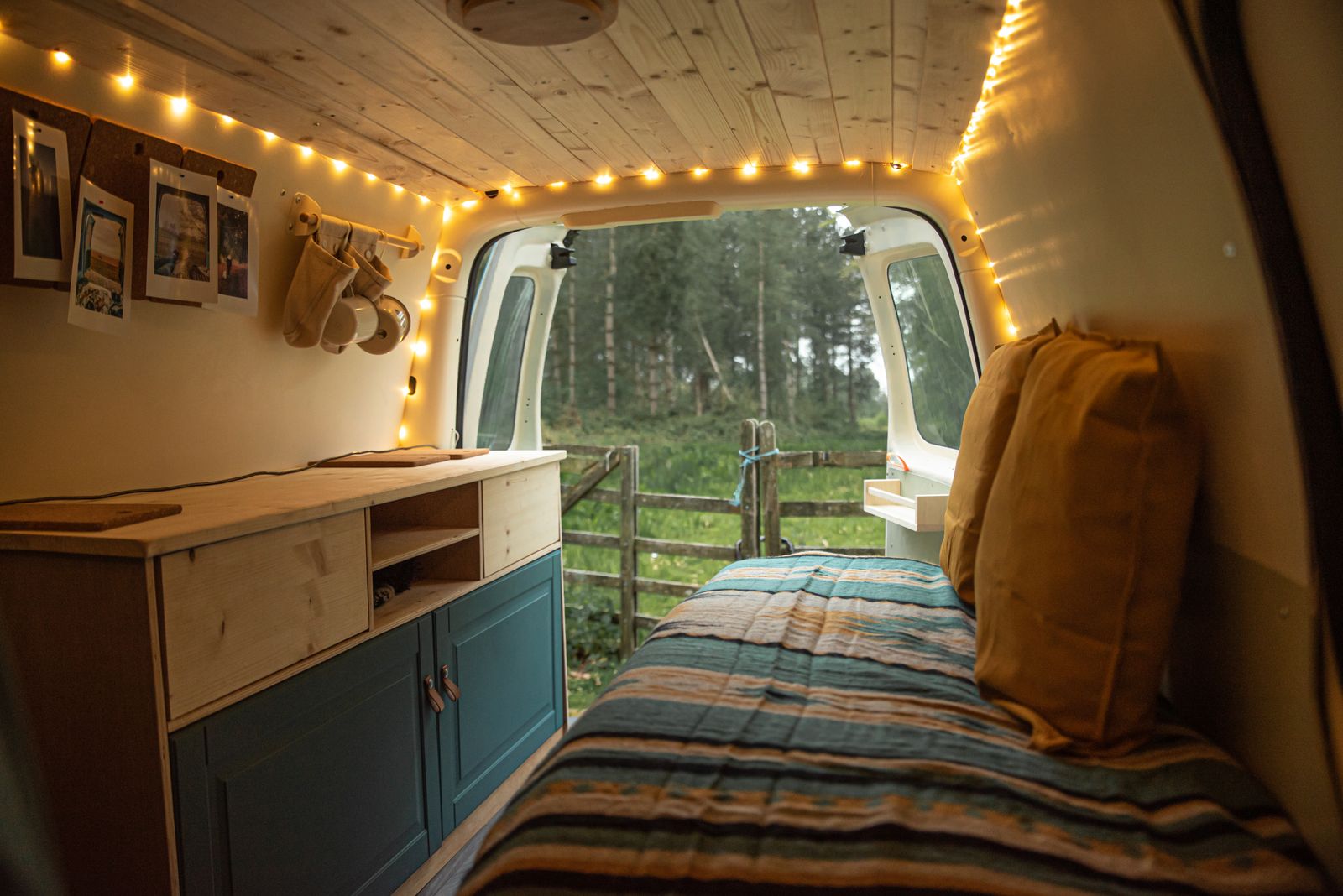
Before you buy anything, find out where you will sleep. In many hatchbacks, estates and SUVs, the rear seats fold to give a flat or nearly flat space from the boot to the back of the front seats. Push the front seats forward, fold the rear seats, and measure the length and width of the space. If you are tall, the length often decides it. In a smaller car, or one whose seats do not fold flat, the back seat itself becomes the bed, which suits a child or a short adult better than a tall one. In a van, the load area is usually the bed, and the question is how to make it warm and comfortable.
What to pack
- To sleep on and in: a mattress or pad, a sleeping bag for the time of year, a pillow and a spare blanket.
- For the windows: curtains, blinds or shades for every window, and something to cover the windscreen.
- For light: a torch or head torch and a light for the inside of the car that runs on its own battery.
- For food and drink: water, food that needs no cooking, and a cool box if the trip is long.
- For the morning: a cloth for the windows, wash things, a bag for rubbish and a phone charger.
Pack the bedding last, so it comes out first, and keep the night things in one bag so you are not unpacking the whole car in the dark.
A trial night
Try a night on the drive before the trip. It shows where the cold gets in, which window lets in the street light, what you forgot, and whether the mattress is long enough, while your own bed is a few steps away.
Drink
A night in the car is not a way to drink and stay with the car. GOV.UK lists being in charge of a vehicle while over the legal limit, or unfit through drink, as an offence separate from driving, with up to three months in prison, a fine of up to £2,500 and a possible driving ban.
Air mattresses and sleeping pads
The difference between a good night and a bad one is mostly what you lie on. Car seats are shaped for sitting, folded seats have ridges and gaps, and a van floor is hard and cold.
Back seat air mattresses
A back seat mattress is an inflatable bed shaped to the rear seat of a car. Most have a raised section or separate pillows that fill the footwell gap between the back seat and the front seats, so the bed is wider than the seat itself. It suits children, or one adult who does not mind lying slightly curled. Check that the mattress fits the width of your back seat and that the front seats can be pushed forward enough.
Boot and load area mattresses
For an estate, an SUV with the rear seats folded or a van, a mattress shaped for the boot and load area gives a longer, flatter bed. Some are cut to clear the wheel arches. Measure the floor between the arches and from the tailgate to the back of the front seats, and compare it with the mattress's size.
Sleeping pads
A self-inflating pad or a foam mat is thinner than an air mattress but less likely to go flat in the night, and it insulates you from the cold floor. Many people use a pad on its own in a van or on top of a mattress in a car in winter.
Things to check
- How it inflates. Many car mattresses come with a pump that runs from the 12V socket. It is quicker than a hand pump, but it draws on the battery if the engine is off.
- Sharp edges. Seat belt buckles, seat runners and the boot's catches can wear a hole in an air mattress. Tuck buckles away and put a blanket underneath.
- A repair patch. Keep one in the bag in case of a slow leak.
Bedding
Bring a proper pillow, or a travel pillow at least, because a rolled-up coat makes for a stiff neck. A fitted sheet or a blanket over the mattress stops the plastic feeling cold and clammy, and a sleeping bag is easier to keep tidy in a small space than loose duvets and sheets.
Browse the car air mattresses and sleeping pads.
Privacy curtains and window blinds
Covering the windows does three jobs. It stops people looking in, it keeps out street lights and the early morning sun, and it adds a layer between you and the cold glass.
Kinds of cover
- Privacy curtains hang on rails, cords or clips along the tops of the side windows and draw across like house curtains. Some cars and vans have a curtain across the back of the front seats to close off the sleeping area.
- Window blinds and covers are cut to the shape of a window and held by suction cups or magnets. Blackout versions keep out the most light.
- Window socks stretch over the whole door frame. With the window partly open underneath, they let air in while keeping insects out.
- Windscreen shades cover the front, which is the biggest window and the one people walk past.
The privacy curtains suit cars and vans, the campervan curtains and blinds are made for a camper's larger windows, and the windscreen sun shades and side window shades do the same job by day.
Take them down before you drive
Every cover comes off before the car moves. The Highway Code says you must be able to see out, and the MOT inspection manual treats an obstruction that significantly affects the view through the area the wipers clear as a major defect. Pack the covers in a bag of their own so they are quick to put up at night and quick to stow in the morning.
Ventilation and condensation
A sleeping person breathes out a lot of moisture overnight. In a closed car it has nowhere to go, so it settles on the cold glass and runs down the windows, and by morning the bedding can feel damp.
Let some air in
The answer is a little fresh air. Open a window slightly on each side, so air can move through, ideally on the side away from the wind and rain. A window sock over the door, or a mesh cover, lets you leave a gap without letting insects in. Keep wet coats and boots out of the sleeping space if you can, because they add more moisture.
In the morning
Wipe the glass with a microfibre cloth and air the car. Before you drive, the Highway Code says the mirrors must be clear and the windows thoroughly demisted. Give the heater and the demister time to work rather than setting off peering through a gap.
No stoves or barbecues inside
Never use a camping stove, a gas heater or a barbecue inside a car or van. Devon and Somerset Fire and Rescue Service warns that barbecues give off poisonous carbon monoxide for hours after you have finished cooking, and says never to use a portable or disposable one inside a tent, vehicle or awning. Cook outside, well away from the car, and only where it is allowed.
The engine
Do not leave the engine running to keep warm through the night. The Highway Code says you must not leave an engine running unnecessarily while the vehicle is stationary on a public road, and running it while you sleep fills the air around the car with exhaust fumes.
Staying warm or cool
Cold nights
A car loses heat quickly once the engine is off, because glass and metal do not insulate. A sleeping bag made for the time of year does most of the work. Add a blanket or a pad underneath you, since much of the cold comes from below, wear a hat, and cover the windows. A hot drink before bed helps.
A 12V heated blanket or a heated seat cover warms the car quickly, but it runs from the 12V socket. With the engine off, everything plugged into the socket draws on the car's battery, and in some cars the socket switches off with the ignition anyway. Read the instructions on whether it should be used with the engine running, use it to warm the bed before you sleep, and switch it off before you go to sleep so you still have a battery to start the car in the morning.
Warm nights
In summer the problem is the opposite. The Highway Code advises keeping the vehicle well ventilated to avoid drowsiness, and the same applies when you are sleeping in it. Park in the shade where you can, open windows behind socks or mesh, and use a 12V or USB fan to move the air. A battery-powered or USB fan running from a power bank does not touch the car's battery. There is more in keeping a car cool in summer.
Dogs
If a dog is travelling with you, never leave it alone in the car on a warm day, even for a few minutes. The RSPCA says opening the windows or parking in the shade won't keep a dog cool enough, and that when it is 22°C outside a car can reach 47°C within an hour.
Food and drink: cool boxes and kettles
Cool boxes and fridges
A 12V cool box or car fridge keeps food and drink cold on the way and overnight. There are two kinds. A thermoelectric cool box is simpler and lighter and keeps things cooler than the air around it. A compressor fridge works like a small fridge at home and holds the temperature you set whatever the weather outside. Both draw from the 12V socket, so think about the battery before you leave either running all night with the engine off. Some have a setting that switches them off when the battery voltage drops, to leave enough to start the car. The guide to 12V car fridges and cool boxes explains the difference in full.
Kettles and cup warmers
A 12V kettle boils water from the car's socket for tea, coffee or a hot water bottle. It takes far longer than a kettle at home and draws a lot of power while it does, so read its instructions about running the engine, and remember the Highway Code's rule on leaving an engine running on a public road. Never boil water while the car is moving. Put the kettle on a flat, steady surface and keep children away from it.
Somewhere to eat
A car tray table on the back of a front seat, or a steering wheel tray when the car is parked, gives you a flat place to eat. Keep a bag for rubbish, and take it with you: the Countryside Code asks visitors to take their litter home.
Light and storage
A reading or roof light that runs on its own battery is better than leaving the car's interior light on all night. Campervan storage and hooks keep clothes, wash things and the torch where you can find them in the dark.
Where you can stop overnight
Where you sleep matters as much as what you sleep on, and the rules depend on whose land it is.
Campsites
The simplest answer is a campsite that takes cars, vans or campervans. You have permission, toilets and often water and electricity, and nobody will knock on the window at midnight.
Car parks and service areas
Many car parks, council and private, have rules on overnight parking or sleeping in vehicles, set out on the signs at the entrance. Read them before you settle down, as they can include charges. Motorway service areas are there for breaks, and the signs say how long you can stay.
Parking on the road
If you park on a road overnight, the Highway Code's parking rules apply. You must not park on a road at night facing against the traffic unless you are in a recognised parking space. Parking lights must be shown on a road or lay-by where the speed limit is over 30 mph, and rule 250 sets out when a car may be left without them. Switch off the engine and headlights and put the handbrake on. Lay-bys on fast roads are noisy, and lorries use them at night.
The countryside
The Countryside Code says some activities, including camping, may need the landowner's permission. It also asks you not to block gateways or driveways when you park. In Scotland, the right to camp under the Scottish Outdoor Access Code does not include motor vehicles: Outdoor Access Scotland says access rights don't include motor vehicles, and that you must respect any parking rules a landowner sets. So the right to wild camp in Scotland does not cover sleeping in a car or van. If in doubt, ask, or use a campsite.
Toilets and water
Plan for the morning as well as the night. Campsites and service areas have toilets; most lay-bys and car parks do not. Carry enough water to drink, brush your teeth and wash your hands, and a bag to take all your rubbish away with you.
Feeling safe
Lock the doors, keep the keys in the same place every night where you can find them in the dark, and keep the phone charged. Pick somewhere lit and with other people about rather than an empty lay-by. If somewhere does not feel right, drive on.
Questions
Can I sleep in my car anywhere?
No. It depends on whose land it is and what the signs say. Campsites are the simplest. Car parks often have rules on the signs, the countryside may need the landowner's permission, and you must not stop on a motorway hard shoulder except in an emergency.
Can I sleep in my car after drinking?
GOV.UK lists being in charge of a vehicle while over the limit as an offence of its own, with a possible prison sentence, fine and ban. Do not plan to drink and sleep in the car.
Can I leave the engine running for heat?
No. The Highway Code says you must not leave an engine running unnecessarily while stationary on a public road, and the fumes are the last thing you want around a car you are sleeping in. Use a good sleeping bag and blankets instead.
How do I stop the windows misting up?
Open a window slightly on each side for air to move through, behind a window sock or mesh if insects are a problem, and keep wet clothes out of the sleeping space. Wipe and demist the glass before you drive.
Do I need a special mattress for a van?
Not a car mattress. A van's load area is wide and flat, so a camping mattress, a foam mattress or a self-inflating pad that fits the floor works well. Put a rug or foam underneath, because a bare metal floor is cold.
Will a cool box flatten my battery overnight?
It can, because it draws from the battery with the engine off. Look for one that switches itself off at a low battery voltage, or run it from a separate power source.
Where to go next
Everything for a night in the car is in the camping and road trips department, and the kit for a long trip is gathered for road trips and camping. Delivery is included in every price and tracked to your door. Other guides that help:
- 12V car fridges and cool boxes: keeping food cold on a trip
- Winter car kit: staying warm and getting going on a cold morning
- Travelling with a dog in the car: if the dog is coming too