A soft light in the footwells or along the dashboard changes how the inside of a car feels at night. It also helps in practical ways: finding a dropped key, reading a map for a passenger, or seeing into the back of a van after dark. This guide explains what ambient lighting is, the kinds of plug-in light you can add yourself, how colours, remotes and apps work, and how to keep lights low and steady so that they never distract the driver or shine where they should not. Every light described here plugs into a USB port or the 12V socket, or runs on its own battery, so there is no wiring into the car.
What ambient lighting is
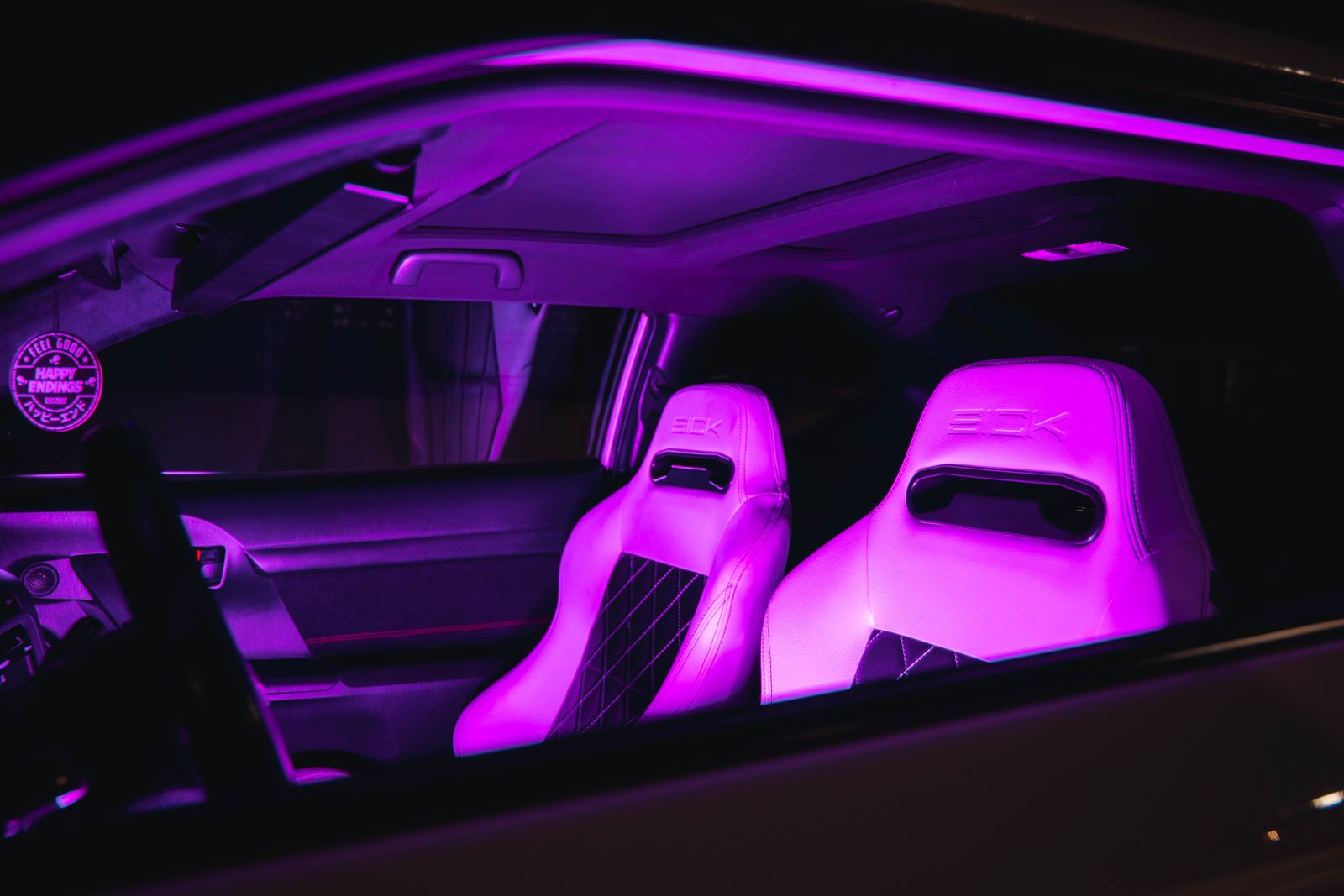
Ambient lighting is low, indirect light inside the car. Rather than one bright bulb in the roof, it is a gentle glow from places you do not look at directly: under the dashboard, in the footwells, along the door panels or under the seats. Many newer cars have it fitted from the factory, often with a choice of colours in the car's settings. Plug-in lighting lets you add a similar glow to a car that does not have it.
Why people add it
Some people simply like the look, and a colour that matches the seats or the stitching makes an ordinary interior feel more finished. Others want light where they need it: a footwell light means a dropped phone can be found without the roof light on, a reading light lets a passenger read without lighting up the whole cabin, and a light in a van's load area makes loading in the dark far easier.
Plug-in, not wired in
Lighting fitted at the factory is wired into the car and controlled from its settings. Adding wired lighting afterwards means taking trim apart and connecting to the car's electrics, which is a job for an auto electrician. The lights in this guide avoid all of that. They take their power from a USB port, from the 12V socket or from their own rechargeable battery, they fix with sticky pads, clips or magnets, and they come out again without leaving a trace. That makes them a good choice for a leased car, a company car or a car you plan to sell, as well as for anyone who would rather not touch the wiring.
What it is not
Ambient lighting is meant to be seen from inside the car and to be dim. It is not meant to light up the road, to be seen by other drivers, or to flash. Those three points come up again in the section on staying safe and legal, because they are where interior lights can cause problems.
LED strips that plug in
The most common way to add ambient light is a set of thin LED strips. A typical set has two or four strips on cables that join at a small control box, with a plug for a USB port or the 12V socket. The strips go under the front of the dashboard and the front seats, so that the light falls into the footwells rather than shining at anyone.
USB or 12V
USB strips are the simplest. They plug into a USB port in the car or into a USB car charger, and in many cars they switch off with the ignition, so they never drain the battery. Strips with a 12V plug use the round socket directly. If your 12V socket stays live when the car is off, a 12V set left on will keep glowing and slowly use the battery, so turn it off when you leave the car or choose a set with a timer. If the USB ports are already busy with phones, a USB car charger or a socket splitter adds ports.
Fitting strips neatly
- Decide where each strip will go and where the cables will run before you peel anything. The control box usually sits under the dashboard or the passenger seat.
- Clean each spot with a dry cloth, or a little alcohol wipe if it is greasy, and let it dry. Sticky pads hold poorly on dusty or shiny plastic.
- Fix the strips so the light points down and back into the footwell, not up at the windscreen or out of the side windows.
- Run the cables along the edges of the carpet and under trim, using the clips that come in the set. Tuck spare cable under a seat rather than leaving it loose.
- Check that nothing hangs near the pedals, catches on the seat runners or crosses the place the seat belt buckles in.
Heat, cold and the sticky pads
The inside of a parked car gets very hot in summer sun and very cold on a winter night, and sticky pads can let go when they are pushed to either extreme. Fixing strips under the dashboard and seats, out of direct sunlight, helps them stay put. If a pad starts to lift, press it back firmly on a warm day, or add one of the small clips that come with most sets. Avoid fixing anything to soft or textured surfaces, such as the carpet or a fabric panel, where pads cannot get a grip.
How many strips
Two strips light the front footwells, which is where most people start. Four strips add the floor behind the front seats, so passengers in the back get the same glow. Measure from the control box to each place a strip will go before you buy, because the cables need to reach without being pulled tight across the floor.
Keep strips and cables away from any panel the handbook marks as an airbag, and do not stick anything to the top of the dashboard where it can reflect in the windscreen. The interior LED strip lights range describes how each set is powered and how long its strips are.
Footwell lights
Footwell lights are small lights that sit under the dashboard or seats and light just the floor. Some are short LED strips; others are compact pods that stick or clip in place, and some run on their own rechargeable battery so there is no cable at all.
The driver's footwell
A light in the driver's footwell needs more care than anywhere else. The pedals need to be clear of everything: cables, clips and the light itself. Mount the light high up under the dashboard, well away from the pedals, and run its cable up and away rather than across the floor. The same thinking applies to floor mats, which must never be able to slide under the pedals, as the floor mats guide explains. Keep the driver's footwell light especially dim. You should see a faint glow, not a lit-up floor, because a bright light below you at night is noticeable in the corner of your eye.
Passengers and the back
The passenger footwell and the floor behind the front seats are the easy places. A battery footwell light that switches on when it senses movement is handy in the back for finding things after dark. The footwell lights range covers both plug-in and battery kinds.
Battery or plug-in
A footwell light on its own battery has no cable to route, which makes it the tidiest choice under a seat or in the back of a van. The trade-off is that it needs charging now and then, and it will not come on with the car. A plug-in light is always ready but needs its cable taken neatly to a port. For the driver's footwell, where a stray cable matters most, a small battery light fixed high under the dashboard avoids the problem altogether.
Reading and roof lights
The roof light fitted to most cars lights everything at once, which is no good if one passenger wants to read while the driver needs the cabin dark. A small reading light gives one person the light they need.
Kinds of reading light
- Clip-on and magnetic lights fix to a seat back, a grab handle or a metal part of the roof and point where you want them.
- Stick-on touch lights sit on the headlining or a panel and switch on with a tap. Most run on their own battery and charge by USB.
- Flexible neck lights plug into a USB port and bend to point at a book or a map.
Children in the back
A soft light in the back helps on a long evening drive: children can find a dropped toy or read without the roof light on. Choose a light that is dim, warm and steady, and fix it where it lights the child's lap rather than the rear window. A light behind the driver that shines into the rear-view mirror at night is as unwelcome as headlights behind you, so check the mirror from the driver's seat with the light on before you set off.
Warm white light is easier on the eyes for reading; cool white shows colours more truly when you are looking for something. Many lights let you choose either.
Vans and campervans
The load area of most vans is dark, with one small light that is easy to block with a load. Battery or USB lights stuck to the roof or the side panels make loading and finding tools in the dark much easier. Look for ones that are bright, run for a good while on a charge and can be turned off easily, because a light left on in the back of a van is easy to forget. The van interior lights range is made for this, and the car reading and roof lights range covers smaller lights for cars. In a camper or a car used for sleeping, a dim warm light is far more pleasant than the roof light, and privacy curtains keep it from showing outside.
Colours, remotes and apps
Most LED sets can show many colours rather than one. The colour, brightness and any effects are chosen with a small remote control, buttons on the control box, or an app on the phone that connects over Bluetooth.
Choosing a colour
Soft colours at low brightness tend to look the most like the lighting fitted in newer cars: a warm white, an ice blue, a pale purple. Strong reds and bright blues look striking when parked, but read the next section before using them on the road. If you want lighting to match the rest of the interior, the pink and cute accessories and carbon and leather styles ranges show the looks people build around.
Brightness
A set that dims a long way is worth more than one that only goes very bright. At night your eyes adjust to the dark road outside, and bright light inside the car works against that. Set the lights low enough that you notice them only when you look down.
Apps, remotes and effects
An app usually gives the most control: an exact colour, a brightness level, a timer and sometimes a schedule. A remote is simpler and does not need the phone. Many sets also have effects such as fading, colour cycling, flashing and a music mode, where a small microphone makes the lights pulse in time with the sound. These are fun when you are parked, but keep the lights on one steady colour whenever the car is moving. Change the settings before you set off: the rules about using a phone while driving apply to a lighting app just as they do to anything else, and the phone holder guide sets them out.
Keeping it safe and legal on the road
Lights inside the car are mostly a matter of good sense rather than law, but a few rules do touch them, and it is worth knowing what they say.
Never dazzle or distract
The Highway Code says you must not use any lights in a way which would dazzle or cause discomfort to other road users, including pedestrians, cyclists and horse riders. A light inside the car that shines out through the windows can do exactly that, so point every light down into the footwells and keep it dim. The Highway Code also asks drivers to avoid distractions. A light that flashes, changes colour or pulses with the music is a distraction for the driver and for the people around you.
What the lighting regulations say
The Road Vehicles Lighting Regulations 1989 control the lights on a vehicle. Among other things, they say:
- no vehicle shall be fitted with a lamp capable of showing a red light to the front, apart from a short list of exceptions;
- no vehicle other than an emergency vehicle shall be fitted with a blue warning beacon or special warning lamp, or anything that resembles one, whether it works or not;
- no vehicle shall be fitted with a lamp that automatically flashes, apart from listed exceptions such as indicators.
The regulations list light to illuminate the interior of a vehicle among the lights allowed to show to the rear. They do not spell out how their other rules treat a plug-in light inside a car. So the sensible course is to make sure that nothing inside your car can be mistaken for a vehicle light from outside: no red showing through the windscreen, nothing blue that could look like an emergency light, and nothing flashing while you drive.
Reflections in the glass
At night, light inside the car reflects in the windscreen and the side windows, and a reflection lies over the view of the road. That is the main practical reason to keep lights low and pointed down. If you can see the lights reflected in the windscreen from the driver's seat, turn them down or move them. The law expects a driver to have a full view of the road and traffic ahead, and nothing inside the car should get in the way of it.
A short checklist
- Lights point down into the footwells or at a passenger's book, not at the glass.
- One steady colour while moving, no flashing, cycling or music mode.
- No red that shows through the windscreen, nothing that could pass for a blue emergency light.
- The driver's footwell is dim, and no cable is anywhere near the pedals.
- Nothing is fixed over an airbag panel.
- Settings are changed only when you are parked.
Questions
Are interior LED lights legal in the UK?
Light inside the car is allowed, and the lighting regulations list interior light among the lights allowed to show to the rear. What can cause trouble is light that dazzles other road users, which the Highway Code forbids, and anything that could be mistaken for a vehicle light from outside, such as red to the front, blue that resembles an emergency light, or flashing. Keep lights dim, steady and pointed down.
Can I have blue lights inside my car?
A soft blue glow in the footwells is a common choice and is not what the rules on blue lights are about. The lighting regulations ban blue warning beacons, and devices that resemble them, on anything but emergency vehicles. Avoid any bright or flashing blue that can be seen from outside the car.
Do these lights need wiring into the car?
No. Every light in this guide plugs into a USB port or the 12V socket, or runs on its own rechargeable battery. Nothing is connected to the car's wiring, and everything can be taken out again.
Will LED lights drain my car battery?
LEDs use very little power. USB lights usually switch off with the car. A 12V set will keep running if your 12V socket stays live with the car off, so switch it off when you leave the car or use a set with a timer.
Can I leave the lights on when the car is parked?
A glow inside a parked car is fine for a short while, but a 12V set left on overnight in a car whose socket stays live will use the battery. Battery lights will simply run flat. A timer, or the habit of switching off as you lock the car, avoids both.
Can I put strip lights along the top of the dashboard?
It is better not to. Light on top of the dashboard reflects in the windscreen at night and lies over your view of the road. Under the dashboard, pointing down into the footwells, gives the same glow without the reflection.
Where to go next
All of the lights in this guide are in sun, light and privacy, and the cordless and rechargeable page gathers everything that runs on its own battery. Delivery is included in every price and tracked to your door. Other guides that help:
- Cute and pink car accessories: lights and decorations in your colour
- Car phone chargers, socket splitters and CarPlay: more USB ports and what the 12V socket can supply
- Sleeping in your car or van: soft light and privacy for a night in the car
- Choosing car floor mats: keeping the driver's footwell clear