Most journeys end without anything going wrong, and the kit in this guide spends years in the boot doing nothing. It earns its place on the one evening it is needed: a flat tyre on a dark lane, a car that stops on a busy road, a collision where someone is hurt, or a long wait for help in the cold. This guide starts with what the Highway Code says to do if you break down, then goes through each piece of kit: what it is for, what to look for, and where to keep it.
If you break down
The Highway Code's rules on breakdowns are clear and short, and they are on GOV.UK. They are worth reading once at home, because nobody reads anything calmly at the side of a road.
On an ordinary road
The first aim is to stop somewhere relatively safe. The Code says the safest place to stop is somewhere designed for parking, so if the car is still moving and you can reach a lay-by, a car park or a side road, use it. Then:
- get the car off the road if you can;
- switch on the hazard warning lights if the car is causing an obstruction, and keep the sidelights on if it is dark or visibility is poor;
- wear light-coloured or fluorescent clothing in daylight, and reflective clothing at night or in poor visibility;
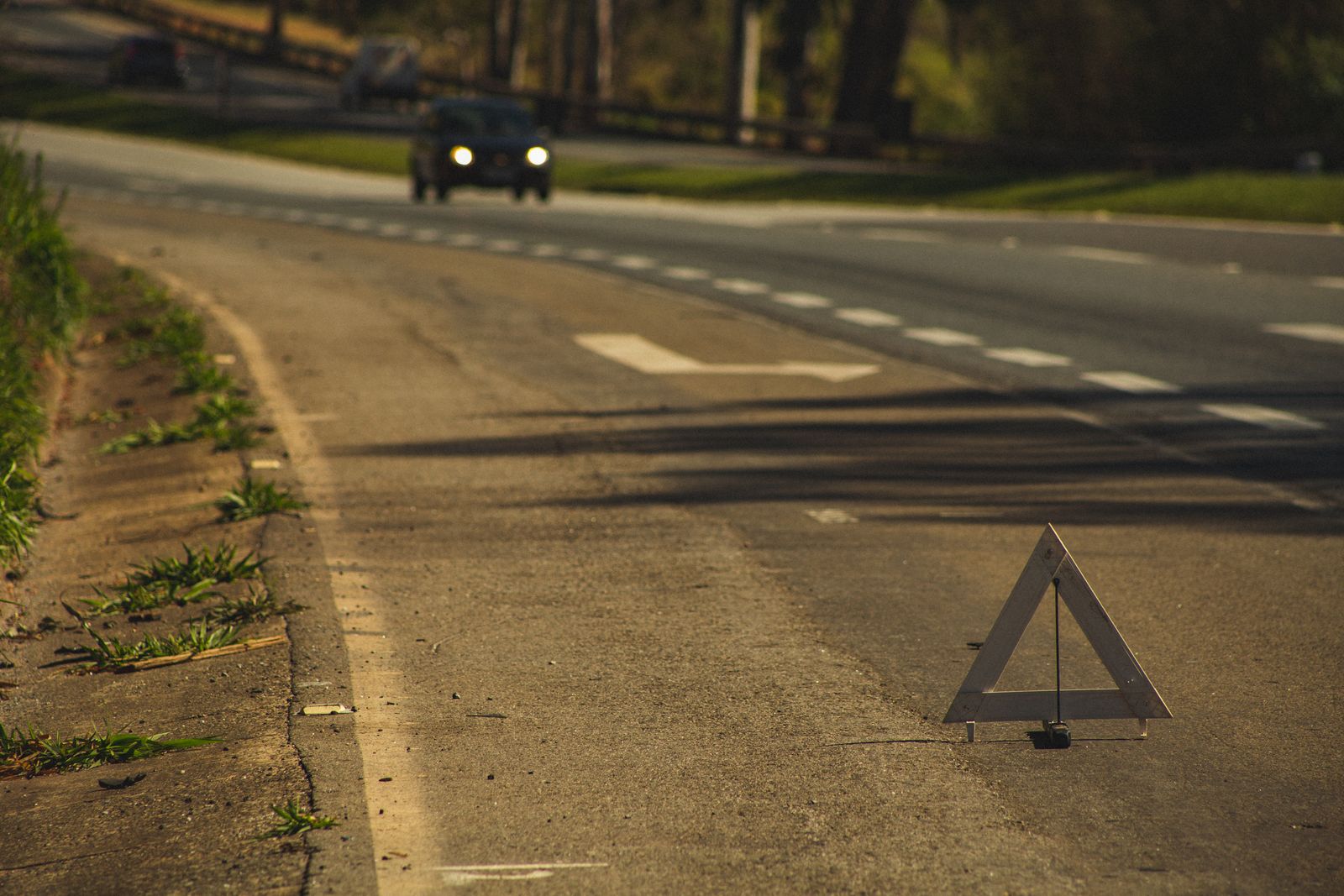
- put a warning triangle on the road at least 45 metres (147 feet) behind the car, on the same side of the road, taking great care as you place it and as you pick it up again;
- do not stand, or let anyone else stand, between the car and oncoming traffic, and at night do not stand where you hide the car's lights from other drivers.
On a motorway
The Code sums up a motorway breakdown as go left, get safe, get help. If you can, leave at the next exit or pull into a service area. If you cannot, pull into an emergency area or onto the hard shoulder, switch on the hazard lights, and the sidelights too if it is dark. Get out by the side furthest from the traffic if it is safe to do so, and make sure your passengers do the same. Put on high-visibility clothing if you have it within easy reach, get behind the safety barrier where there is one, and wait well away from the car and the traffic. Do not go back to the car once you have left it. Use the free emergency telephone for help. A warning triangle must never go on a motorway.
If you have a dog with you, the Code says animals must be kept in the vehicle or, in an emergency, under control on the verge. That is one more reason to have a lead in the car as well as the dog's restraint; see travelling with a dog in the car.
If you cannot get off the carriageway
If you cannot reach the left-hand lane or a place of relative safety, and you cannot get out of the car safely, the Code says to stay in the car, keep your seat belts and hazard warning lights on, and call 999 straight away and ask for the police. If the car has an SOS button, you can press that and ask for the police instead. A driver whose disability stops them getting out does the same: hazard lights on, seat belt on, 999.
After a collision
If there has been a collision, the Code's advice is to stop somewhere relatively safe if you can, use the hazard lights, put on high-visibility clothing if you have it, and call 999 with full details of where you are and of anyone hurt. Be prepared to give first aid, and stay until the emergency services arrive. Do not move injured people from their vehicles unless they are in immediate danger.
Calling for help
Every one of those situations ends with a phone call, which is why the Code recommends, for emergency use, that you carry a mobile phone with your emergency contacts in it, such as your breakdown provider. Save the number before you need it, along with your policy number if you have one, and keep the phone charged. A USB-C car charger in the 12V socket means the phone is topped up by the time you arrive, rather than running flat on the way.
What to keep, and where
The Highway Code recommends high-visibility clothing for emergency use as well as the phone, and it mentions a warning triangle and first aid in the rules above. Put together, a sensible kit for most cars looks like this:
- Within reach of the seats: a hi-vis vest for the driver and for anyone who often travels with you, the phone and its charger, a torch, and a safety hammer with a belt cutter.
- In the boot: a warning triangle, a first aid kit, a tyre inflator, and in winter a blanket and warm clothes.
The point of the split is that some things are needed before you get out of the car, and on a motorway you may not be able to walk round to the boot at all. A car emergency kit puts several of these pieces in one bag, which is the easiest way to start if the car has nothing yet.
First aid kits
The Highway Code's annex on first aid on the road opens with a plain instruction: always carry a first aid kit. You may never need it, but it could save a life. The same annex says it is no substitute for proper training, and suggests learning first aid from a qualified body such as St John Ambulance, St Andrew's First Aid or the British Red Cross.
The British Standard for vehicle kits
There is a British Standard for what goes in a first aid kit for a vehicle: BS 8599-2. It sets out three sizes of kit, small, medium and large, and the right size is chosen by the type of vehicle and the number of passengers it carries. A kit described as made to BS 8599-2 has a set list of contents for its size, which takes the guesswork out of it. Other kits are put together to their own list, which may be fine for a car, but read the list to see what you are getting.
What to look for
- A printed list of contents. It tells you what is in the kit and what to replace after you use something.
- A case you can open quickly. A soft bag with a wide zip or a hard case with clear compartments is easier to use in the dark than one packed so tightly that everything falls out.
- Gloves. Disposable gloves protect you and the person you are helping.
- A size that suits the car. A compact kit fits in the glovebox or a door pocket. A bigger kit for a van, a people carrier or a car that carries a lot of passengers lives in the boot.
Keeping it ready
Sterile dressings and wipes carry use-by dates, so check the kit once a year, perhaps when the car has its service or MOT, and replace anything out of date or used. If someone who travels with you needs a particular medicine, keep it with them rather than in the kit, so it is not left in a hot or freezing car for months. Keep the kit somewhere it cannot slide about: the Highway Code asks you to secure heavy or sharp objects, because in a collision loose things can hit the people inside. A boot organiser gives it a place of its own. Browse the car first aid kits by size.
Warning triangles and hi-vis vests
A triangle and a vest do the same job in different ways: they make you and the car easier for other drivers to see in time.
Warning triangles
A warning triangle stands on the road behind the car and warns drivers coming up behind that something is stopped ahead. The Highway Code says to place it at least 45 metres (147 feet) behind the car, on the same side of the road, and to take great care as you place it and as you collect it. It also says plainly that triangles must never be used on motorways, where walking back along the hard shoulder would put you in more danger than the triangle saves.
Most triangles fold flat into a slim case and open out into a triangle on a stand. Things to look for:
- A steady base. Wide or weighted feet stop it blowing over in the wind or the draught from passing lorries.
- Reflective and fluorescent faces. A reflective border shows up in headlights at night, and a fluorescent centre stands out in daylight.
- A case that stays shut. It will live in the boot for years, so it should not rattle open.
Open the triangle once at home, so you know how its legs fold out. Doing it for the first time in the rain, at night, beside traffic, is not the time to learn.
Hi-vis vests
The Highway Code recommends having high-visibility clothing for emergency use, and its breakdown rules say to wear light-coloured or fluorescent clothing in daylight and reflective clothing at night or in poor visibility. A hi-vis vest does both: fluorescent yellow or orange fabric for daylight and reflective bands for headlights.
Where it lives matters more than which one you buy. On a motorway the Code says to put on high-visibility clothing if it is within easy reach, so a vest in the boot may stay there. Keep one in the driver's door pocket or the glovebox, put it on before you get out, and keep one for each person who often travels with you. A door pocket organiser stops it disappearing under everything else.
Driving abroad
Some countries have their own rules about kit drivers must carry, and they are not the same as ours. Before you drive abroad, read GOV.UK's travel advice for each country you will drive through. It points to GOV.UK's guidance on driving abroad and to that country's driving rules. The warning triangles and hi-vis vests range has both.
A torch
At night you need light to read the handbook, look at a tyre, find the triangle in the boot and see the ground on the verge. A phone has a torch, but using it drains the battery of the one thing you need for the call for help.
Kinds of car torch
- Rechargeable torches charge from a USB port in the car or at home. They are always ready if you keep them charged, and many show how much charge is left.
- Battery torches run on ordinary batteries. Spare batteries are easy to carry, but old batteries left in a torch for years can leak, so check it now and then.
- Head torches leave both hands free, which is what you want when you are holding a wheel nut or a triangle.
- Work lights with a magnetic or hooked base can be stuck to the car body or hung from the bonnet so the light points where you are working. Some have a flashing red mode as well as a white light.
Using it safely at the roadside
A torch helps other drivers see you as well as helping you see. Even so, the Highway Code's rules still apply: stay off the carriageway, do not stand between the car and the traffic, and at night do not stand where you hide the car's lights. Keep the beam low and away from drivers coming towards you.
Keep the torch where you can reach it from the driver's seat, in the glovebox or a door pocket, rather than at the bottom of the boot, because you will want it before you get out. Browse the car torches, and for light inside the car when you are parked, the reading and roof lights.
Safety hammers and belt cutters
A safety hammer is for the rare emergency in which you cannot get out by the doors: after a collision that has jammed them, or if the car has ended up in water. Its hardened point puts the whole blow on one spot of a side window. Most also have a belt cutter, a short blade inside a hooked guard that cuts a jammed seat belt without cutting the person wearing it.
What the fire service says
The National Fire Chiefs Council's guidance, written for fire control rooms advising people trapped in a vehicle in water, makes two points that help explain how a hammer is meant to be used. First, open the windows or sunroof as early as possible, so they are ready as a way out if needed. Second, side windows are usually the weaker ones, and can be broken with a firm, hard blow in the corner of the window with a life hammer. If you are ever in that situation, call 999 as soon as you can and follow what the operator tells you.
Kinds of tool
- Hammer style: a handle with a pointed metal head, often with a belt cutter in the handle. Some have a bracket to fix them in the car.
- Spring-loaded punches: a small tool you press against the window until a spring fires a pin into the glass. They need less of a swing, which helps in a cramped car.
- Keyring tools: small punches and cutters that go on the car keys, so the tool is always in the car while you are.
Where to keep it
A safety hammer is only any use if you can reach it while you are still strapped into your seat. That rules out the boot and the far end of the glovebox. A holder on the centre console, a door pocket on the driver's side or a keyring are all within reach. Wherever it goes, it must not be loose: a hard metal tool rattling around the cabin is exactly the kind of object the Highway Code asks you to secure. The belt cutter has a real blade, so keep it out of the reach of children in the back. The safety hammers and belt cutters range has the different kinds.
Portable tyre inflators
A portable tyre inflator is a small air pump that runs from the car's 12V socket or from its own rechargeable battery. It puts air back into a tyre that has lost some, which is far and away the most common tyre job, and it lets you check and set the pressure at home instead of queueing at a garage air line.
What the Highway Code says about tyres
The rules on tyres are in the Code's annex on vehicle maintenance. Tyres must be inflated to the vehicle maker's figure for the load the car is carrying. Check them every week, before a journey, while they are cold, because warm tyres can give a misleading reading. Cars and light vans must also have at least 1.6 mm of tread across the central three-quarters of the tyre, all the way round. The right pressures for your car are in its handbook, and many cars also have them on a label inside the driver's door frame or the fuel filler flap.
What an inflator does at the roadside
If the tyre is low but holding air, an inflator can bring it back up to pressure so you can drive on carefully and have it looked at. It cannot fix a tyre that is cut, torn or badly damaged, or one that has come off the rim. The Code's advice for a flat is to stop as soon as it is safe, and to change the wheel yourself only if you can do it safely; otherwise call your breakdown provider. If a tyre bursts while you are driving, hold the wheel firmly, keep control and let the car slow down and stop at the side of the road.
Check what your own car carries: a full spare wheel, a narrower space-saver spare, or a repair kit instead of a spare. The handbook says which, and how to use it.
What to look for
- 12V or cordless. A 12V inflator runs from the socket for as long as you need. A cordless one is easier to carry round all four wheels, but has to be kept charged.
- A clear gauge. A digital display that you can read in the dark helps.
- Auto shut-off. You set the pressure you want and it stops when it gets there.
- A long enough lead and hose to reach the far wheels from the socket.
There is more on choosing and using one in portable tyre inflators explained. Browse the portable tyre inflators.
Questions
How far behind the car should a warning triangle go?
The Highway Code says at least 45 metres (147 feet) behind the car, on the same side of the road. Take great care putting it out and bringing it back, and never use one on a motorway.
Should I stay in the car if I break down on a motorway?
If you can get out safely, no: leave by the side away from the traffic, get behind the barrier and wait away from the car. If you cannot reach the left or a place of relative safety, and cannot get out safely, the Code says to stay in with your seat belt and hazard lights on and call 999 for the police.
Where should I keep the hi-vis vest?
In the car, within reach of the driver's seat, such as the door pocket or glovebox. On a motorway the Code says to put it on if it is within easy reach, so a vest in the boot may not get worn.
What should a car first aid kit have in it?
A kit made to BS 8599-2, the British Standard for vehicle first aid kits, has a set list of contents for its size. Whatever you choose, it should have a printed list, gloves, and dressings within their use-by dates. The Highway Code also suggests learning first aid properly.
Do I need different kit to drive abroad?
Some countries have their own rules on what drivers must carry. Read GOV.UK's travel advice for each country you will drive through before you go.
Where to go next
Everything in this guide is in the safety and emergency department, and a ready-made emergency kit is the quickest place to start. If it will be dark and cold, add a 12V heated blanket and an ice scraper for the winter. Delivery is included in every price and tracked to your door. Other guides that help:
- Winter car kit: the extra things to carry when the weather turns cold
- Choosing a car phone holder: what the law says about your phone in the car
- How to choose a dash cam: a record of what happened if there is a collision