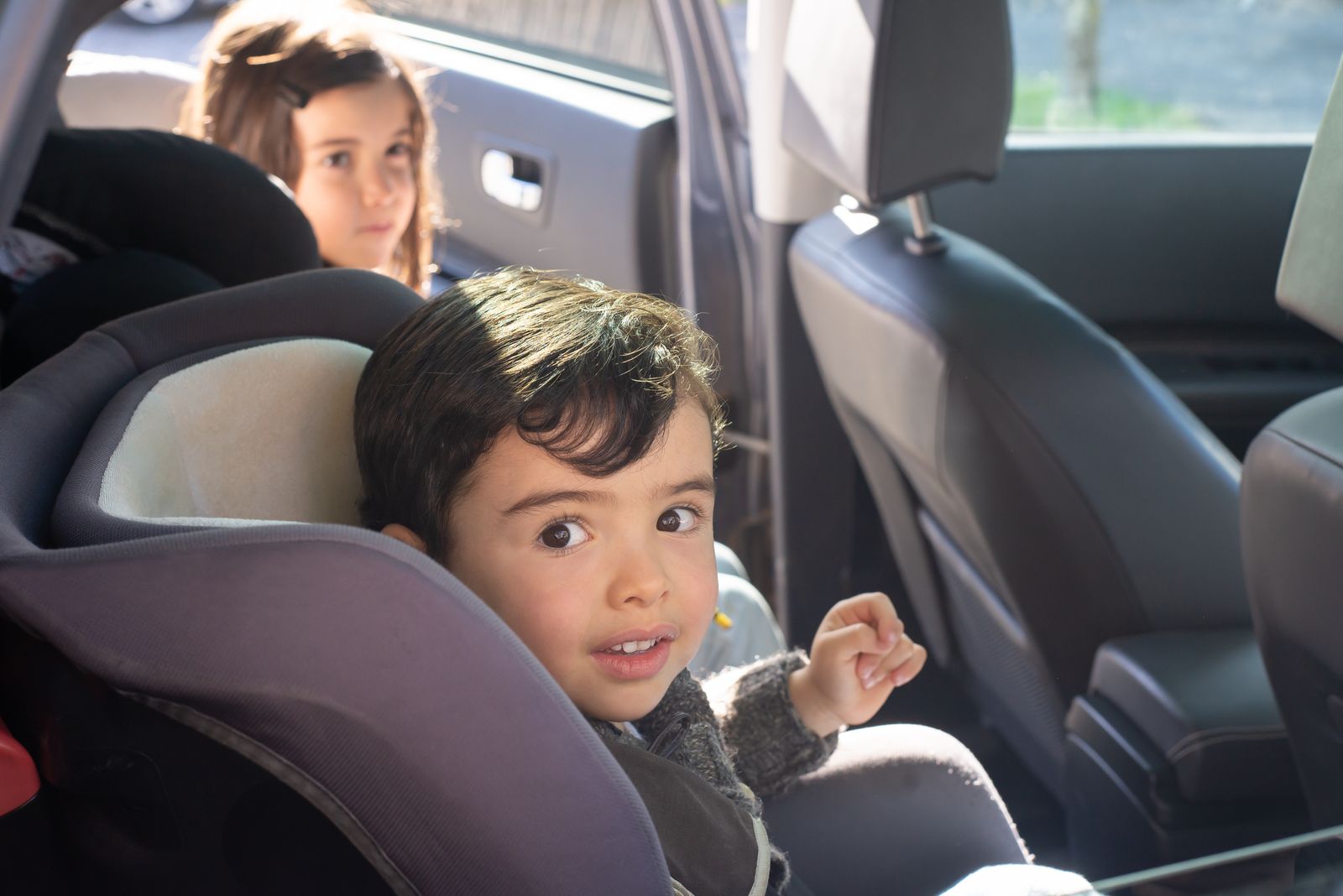
A car journey with children is easier when everything they need is within reach, nothing is rolling around the floor, the sun is out of their eyes and the seats underneath them are protected. It is safer, too, when the driver is not twisting round to pass a drink or pick up a dropped toy. This guide starts with the checks worth making before you set off, then goes through back seat organisers and kick mats, baby mirrors, travel trays, sun blinds, protecting the seats under a child seat, and planning a long journey with children in the back.
Before you set off
Most of what makes a journey with children go well happens before the car moves.
The child seat comes first
This guide is about the things around a child seat, not the seat itself. What the law asks of the seat is simple to state. GOV.UK's page on child car seats says children must normally use a child car seat until a set age or height, that only approved seats can be used, and that you must check the seat suits your child. The Highway Code, in rule 100, says the driver must make sure children under 14 use a seat belt or an approved child restraint, and that the restraint must suit the child and be fitted to the manufacturer's instructions. So the seat must suit the child, and it must be fitted exactly as its maker's instructions say. Rule 101 adds one rule that matters wherever the seat goes: a rear-facing baby seat must never be fitted in a seat protected by an active frontal airbag, because in a crash the airbag could seriously injure or kill the child. The car's handbook shows where the airbags are and how, if at all, the passenger airbag can be switched off, and the child seat's own instructions say which seats it can be used in. Read GOV.UK's page for the detail, and keep the seat's own instructions somewhere you can find them, such as in a seat back pocket.
Getting in and out
Rule 102 of the Highway Code asks drivers carrying children to let them get in and out by the door on the kerb side, away from passing traffic, to use the child safety door locks where the car has them, and to keep children under control. In a hire car or a grandparent's car, check the child locks each time.
Nothing loose in the back
A car full of children fills up quickly with bags, bottles, books and toys. The Highway Code's Annex 6 asks drivers to make sure luggage is securely stowed, and rule 98 says that any heavy or sharp objects should be secured safely. Anything left loose on the back seat or the parcel shelf can be thrown forward under hard braking, so put the heavy things in the boot, and keep in the cabin only what the children need on the way, stowed in an organiser or a bag that cannot slide about.
A short checklist
- Each child seat fitted to its instructions and suited to the child in it, with the harness or belt adjusted.
- Child locks on, where fitted.
- Drinks, snacks, wipes, a change of clothes and a bag for rubbish packed where an adult can reach them at a stop.
- Toys and books for the journey in the organiser, not on the floor.
- Sun blinds up on the back windows if the sun will be on that side.
- Your own seat, mirrors and head restraint set before you pull away, as rule 97 of the Highway Code asks.
Back seat organisers and kick mats
An organiser hangs on the back of a front seat and turns it into storage that faces the child. A kick mat is the simpler version, a panel that protects the seat back from small feet. Many products combine the two.
Kick mats
Children in child seats sit higher than adults and closer to the seat in front, and their shoes end up against the back of the driver's or passenger's seat. Over months that leaves scuffs, mud and the occasional bit of chewing gum on the fabric or leather. A kick mat is a waterproof panel that straps over the seat back, usually with one strap round the headrest posts and another round the bottom of the seat. It takes the marks instead and wipes clean. Look for one that covers the whole of the seat back down to the floor, because that is where shoes land, and for straps that can be pulled tight so the mat does not sag.
Organisers with pockets
An organiser adds pockets to the kick mat: some for bottles and drinks, some for books and colouring, and often a clear pocket on the front that holds a tablet so a child can watch it. The value is that the child can reach their own things without asking, and the adult in front does not need to turn round to hand them over.
What to look for
- Pockets a child can use. Deep, open pockets are easier for small hands than zips or tight flaps.
- Soft contents. Fill the pockets with soft, light things. Heavy items, glass bottles and hard toys are better in the boot, for the same reason as above.
- A firm fit. Straps that buckle and tighten hold the organiser flat against the seat, which stops it swinging and keeps it out of the child's face.
- Wipe-clean fabric. Spills are part of the job, so a surface that wipes clean saves washing it every week.
The back seat organisers and kick mats range has both kinds. A car tissue box that straps to a headrest or sits in a seat pocket, and a small car bin for wrappers and peel, keep the two things families reach for most close at hand.
Baby mirrors for rear-facing seats
A baby in a rear-facing seat faces the back of the car, so from the driver's seat you cannot see their face. A baby mirror solves that. It is a large, slightly curved mirror that straps to the headrest of the seat in front of the baby. The baby can see themselves in it, and you can see the baby's face in your own rear-view mirror without turning round.
Fitting it
Most baby mirrors fasten with two straps round the headrest, one across the top and one round the posts, and tilt on a joint so you can angle the mirror once it is in place. Fit and angle it while the car is parked and you are sitting in the driver's seat, so you can see the reflection exactly as you will on the road. Pull the straps tight. A mirror is a hard object near a child's head, so it needs to be firmly attached, and most baby mirrors are made of shatter-resistant plastic rather than glass.
Using it without being distracted
The point of a baby mirror is that a short glance tells you the baby is fine, so you do not need to turn round or pull over to check. It should never become something you watch. The Highway Code's rule 148 says safe driving needs concentration and lists things that take your attention away from the road. A mirror that tempts you into long looks has the same effect. Glance, as you would at any mirror, and if the baby needs you, find somewhere safe to stop.
Things to check
- The mirror must not block your view out of the rear window in your own rear-view mirror. If it does, lower it, angle it differently or choose a smaller one.
- Some mirrors have lights or a remote. Keep any light dim and use it only when you need it, because a bright light behind you at night is a distraction.
- If a tablet is mounted near the mirror for an older child, check from the driver's seat that you cannot see the screen in either mirror. The law on screens visible to the driver, covered under long journeys below, counts a screen seen by reflection.
The baby car mirrors range shows the different sizes and mountings.
Travel trays for snacks and colouring
A travel tray gives a child in a child seat a flat surface in front of them. It is usually a padded tray with raised sides, so crayons and snacks do not roll off, held on by straps that go round the child seat or the child's waist. Many have pockets around the edge for pens, toys and a drink, and some have a clear holder for a tablet in the middle.
How they fit
Most trays strap around the back of the child seat or around the child, rather than to the car. Before you buy, check that the straps will go round the child seat you have without crossing the harness or the seat belt, and that the tray does not press on the child's tummy or legs. A tray should never be fitted in a way that changes how the harness or belt sits on the child, so if the only way to fit it is over the straps, it is the wrong tray for that seat. Take it off for sleep.
What it is good for
A tray turns the back seat into a small table: colouring, stickers, small building toys, a puzzle book or a snack. Raised edges matter: without them, every pencil ends up in the footwell. A tray with a waterproof, wipe-clean surface copes with the yoghurt as well as the pens.
Snacks and drinks
Choose snacks that are easy to eat sitting down and leave few crumbs, and drinks in bottles that close. Hand them out before you pull away or at a stop, so the driver is not passing things backwards on the move. Rule 148 of the Highway Code lists eating and drinking among the things that distract a driver, which is another reason to let the children have the tray and keep the driver's hands on the wheel.
Browse the kids travel trays with your child seat's shape in mind.
Sun blinds for the back windows
Low sun through a side window falls straight on a child in a child seat, and children often cannot move out of it. A blind on the back window takes the glare off their eyes and keeps the seat cooler.
The kinds of blind
- Static cling shades are thin sheets of film that stick to the glass with no adhesive. They are quick to put up, can be moved, and you can see through them, but they do not cover the whole window.
- Suction cup shades are mesh panels on a wire frame held up by small suction cups. They cover more of the glass and fold flat when not in use.
- Roller blinds clip to the top of the window and pull down to a hook, so they can be raised and lowered as the sun moves.
- Window socks are stretchy mesh sleeves that pull down over the whole rear door frame. They cover the entire window, and the window can be opened a little behind them for air.
Where they can go
The rules on darkened glass, set out on GOV.UK, are about the windscreen and the front side windows, which must let a stated amount of light through. There are no rules for tinting the rear windscreen or the rear passenger windows. A blind is not tint, but the same thinking applies on the road: keep shades on the windows behind the driver, never on the windscreen or the front side windows while you are driving. The Highway Code's Annex 6 says windscreens and windows must be kept free from obstructions to vision, and you still need to see out to the sides and behind. Before you set off, sit in the driver's seat and check that the blinds do not hide anything you need to see over your shoulder or in your mirrors. The rear window blinds for children and side window sun shades ranges cover each kind.
Getting the size right
Measure the visible glass of the rear side window, height and width, and compare it with the size of the blind. A blind that is slightly smaller than the glass is fine. One that is larger will buckle, fold over at the edges or fail to stick. For window socks, check that the sock is made for the door shape: they fit most rear doors with a frame round the window, but not every shape. The guide to choosing car sun shades covers windscreen shades for a parked car as well.
Protecting the seats under a child seat
A child seat pressed into the car's seat for years leaves marks: dents in the foam, rubbed fabric, crumbs pushed into the seams and spilt milk soaked into the cushion. A seat protector is a mat that sits between the child seat and the car seat to stop that.
What a seat protector is
Most are a firm, non-slip mat that covers the seat base, with a raised back panel that runs up the backrest, held by a strap round the headrest. The better ones have a lip at the front edge to catch crumbs and drips and keep them off the front of the seat, and a pocket or two on the front facing the footwell. The surface is wipe-clean, and the underside grips the seat so it does not move.
The child seat's instructions come first
A child seat works by being held firmly against the car, by the seat belt or by the car's fixing points. Anything between the two must not stop that. So before you use a protector, read the child seat's instructions. If they say nothing should go between the child seat and the car seat, follow that and leave the protector out. If a protector can be used, fit it first, then fit the child seat on top exactly as its instructions say, and check that the seat is as firm as it is without the protector. Choose a thin, firm protector rather than a thick, soft one, and make sure it leaves the fixing points and the seat belt buckle clear.
Other ways to protect the seats
For the seats that are not under a child seat, waterproof car seat covers keep spills and muddy shoes off the fabric, and a kick mat protects the back of the seat in front, as above. The guide to choosing car seat covers explains materials and fitting, including what to check if your seats have side airbags. On the floor, rubber mats hold crumbs and spilt drinks where they can be tipped out, and the guide to choosing car floor mats covers those.
The seat protectors for child seats range shows the different shapes.
Long journeys with children
A long drive with children is mostly about rhythm: stops before anyone needs one, something to do between stops, and a car that stays comfortable.
Plan the stops
The Highway Code's rule 91 recommends a break of at least 15 minutes after every two hours of driving. With children you will often stop more than that, and it helps to plan for it rather than be surprised. Take the toilet stop before the long stretch, not when it becomes urgent on a motorway.
Screens in the back
A tablet in a headrest tablet holder can make a long journey go quickly for an older child. There is one rule to know. The Road Vehicles (Construction and Use) Regulations say no one may drive where the driver can see, directly or by reflection, a screen showing anything other than information for driving, such as navigation or the car's own information. A film on a tablet in the back is fine for the passengers, as long as the driver cannot see it, either straight on or in a mirror. Check from the driver's seat before you set off. Rule 150 of the Highway Code adds that drivers should not be distracted by screens. Headphones for the children keep the sound in the back, too, which the Highway Code also has in mind: rule 148 lists loud music as a distraction.
Food and drink
Pack more water than you think you will need. A 12V cool box keeps drinks and lunches cold for a day out and saves stopping to buy food. Hand out food at stops or before you set off where you can, and keep wipes and a bag for rubbish in reach of the adult who sits nearest the children.
Heat
The UK Health Security Agency's hot weather advice on GOV.UK says small, closed spaces such as stationary cars can get dangerously hot very quickly, and that babies and children should not be left alone in stationary cars. On the move, blinds on the back windows and good air flow keep children more comfortable, and a child who is quiet may simply be too warm, so check at each stop.
Smoking
Rule 148 of the Highway Code also says that in England and Wales you must not smoke, or let anyone else smoke, in an enclosed private vehicle carrying anyone under 18. Scotland has its own law to the same effect.
Keeping the car tidy on the way
Ten minutes at the end of the journey saves an hour later. Empty the bin, take the wrappers out of the organiser, shake out the mats and wipe the trays. Once a week, a car vacuum cleaner gets the crumbs out of the seat seams and from under the child seats, and an interior cleaning kit deals with sticky marks on the plastics.
Questions
Is it safe to fit a baby mirror on the back seat headrest?
Baby mirrors are made to strap to a rear headrest. Fit it tightly so it cannot come loose, angle it while parked, and check it does not block your view out of the rear window. Use it with short glances only.
Can I put a seat protector under a child seat?
Only if the child seat's instructions allow it. If they do, use a thin, firm protector, fit the child seat on top exactly as its instructions say, and check it is still held firmly.
Can my children watch a tablet while I drive?
Yes, as long as you cannot see the screen, directly or in a mirror. The law forbids driving where the driver can see a screen showing anything other than driving information.
Are sun blinds on the back windows legal?
GOV.UK's rules on darkened windows cover the windscreen and front side windows only. Keep blinds on the rear windows, and check from the driver's seat that you can still see out behind and to the sides.
Do I need to keep toys in an organiser?
The Highway Code asks drivers to stow luggage securely and secure heavy or sharp objects. Soft toys in an organiser are fine. Keep heavy and hard things in the boot.
Where to go next
Everything in this guide is gathered in the range for families with children. Delivery is included in every price and tracked to your door. Other guides that help:
- Choosing car seat covers: protecting the seats from spills and shoes
- Choosing car floor mats: mats that hold crumbs and spilt drinks
- How to organise your car: storage for the whole car, not only the back seat
- Travelling with a dog in the car: when the family includes a dog